GOP Lawmakers Push to Close Potential Loophole, Reaffirming Citizenship Requirement for All Elected Posts
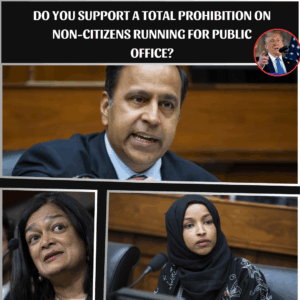
The debate over election integrity and the fundamental definition of U.S. political representation has intensified with a pointed question: DO YOU SUPPORT A TOTAL PROHIBITION ON NON-CITIZENS RUNNING FOR PUBLIC OFFICE? While federal law already mandates citizenship for positions in Congress and the Presidency, the question highlights a growing push by conservatives to close perceived loopholes and prevent non-citizens from holding any elected position, particularly at the state and local levels.
The image prominently features several high-profile progressive Democratic lawmakers—Reps. Pramila Jayapal, Raja Krishnamoorthi, Ilhan Omar, and Alexandria Ocasio-Cortez (AOC)—who are often associated with strong pro-immigrant policies, framing the issue as a direct clash with progressive political power.
The Legal and Political Conflict
The controversy focuses primarily on local and municipal elections, as the U.S. Constitution is clear on federal requirements:
-
Federal Offices: The Constitution mandates that Representatives (like those pictured) must be U.S. citizens for at least seven years, Senators for nine years, and the President must be a “natural born” citizen. All the Representatives shown are citizens and legally eligible to hold office.
-
Local/Municipal Offices: Currently, a few jurisdictions—such as certain cities in California and Maryland—have taken steps to allow non-citizens (often legal residents or green card holders) to vote in local elections or serve on local boards. This is the area targeted by those advocating for a “total prohibition.”
Proponents of the ban argue that allowing non-citizens to hold any public office, regardless of level, fundamentally dilutes the value of citizenship and allows foreign interests to potentially influence U.S. governance, particularly on issues like immigration, schools, and local budgets.
Opponents, largely Democrats and civil rights groups, argue that allowing non-citizens to participate in local governance is crucial for ensuring that communities, regardless of immigration status, have their voices heard on issues that directly impact their daily lives, such as schools and local ordinances. They view the prohibition push as an attempt to strip power from minority communities.
The Progressive Target
The inclusion of Jayapal (who was born in India), Omar (a refugee from Somalia), and the outspoken AOC and Krishnamoorthi is a clear political maneuver. These lawmakers, while fully credentialed citizens, are often criticized by the right for their progressive stances on immigration, asylum, and border enforcement.
By using their images, conservatives seek to tie the perceived “threat” of non-citizen involvement in politics to the broader, disliked policies of the Democratic progressive wing. The visual implication is that the policies these Democrats advocate for could lead to a system where non-citizens gain undue political power.
The debate is less about the current legality of federal offices and more about setting a strict, uncompromising ideological boundary for U.S. political participation.